








■By Qu Jingfan
In recent years, Chinese literature has gained significant attention in English-speaking countries, largely due to the success of the English translations of works like Mai Jia's Decoded (《解密》), Liu Cixin's The Three-Body Problem (《三体》), and Jin Yong's wuxia series in mainstream Western markets. The prosperity of these translations has created ripples in other countries such as Germany, France, and Japan, leading to translations in more languages. Some Chinese literary works have even become bestsellers overseas. What is the key to the success of foreign literature in English-speaking countries? What elements truly captivate Western publishers and readers?
According to Paper Republic, a Chinese literature translation website, around 30 Chinese literary works have been published in English annually in recent years. In 2024, the number has reached 31, with more and more works among them winning or being shortlisted for international literary awards.
In recent years, the range of Chinese literary works reaching English readers has grown significantly, encompassing contemporary literature, classical works, poetry, children's books, science fiction, wuxia, crime novels, and even web literature. Esteemed authors such as Mo Yan, Yu Hua, Ge Fei, Su Tong, Xu Zechen, Mai Jia, Liu Cixin, Chi Zijian, Dong Xi, Liu Zhenyun, Shuang Xuetao, Zhang Yueran, Eileen Chang, Jin Yong, Cao Wenxuan, Chen Jiatong, and Nie Jun have all gained readers internationally.
Notable achievements include Mo Yan's 2012 Nobel Prize in Literature and the success of Zhang Yueran's novel Cocoon (《茧》). Translated into English by Singaporean translator Jeremy Tiang and published by World Editions in 2022, Cocoon won the inaugural Best Translation Award at the 2024 Singapore Literature Prize. Prominent media outlets like The Wall Street Journal and The Guardian featured reviews of the book. In August 2025, Penguin's Riverhead Books imprint will release a hardcover edition of Cocoon. Similarly, Mao Dun Prize-winning author Xu Zechen's Beijing Sprawl (《北京西郊故事集》), which was published by Two Lines Press of American Center for the Art of Translation, was shortlisted for the 2023 Cercador Prize. Screenwriter and poet Zou Jingzhi's memoir Ninth Building (《九栋》), published by Honford Star, was shortlisted for the 2023 International Book Prize. Meanwhile, web fictions by Tian Xia Ba Chang and Mo Xiang Tong Xiu, along with Chen Jiatong's children's book White Fox (《白狐迪拉》), have entered international bestseller lists.
The Charm of a Great Story
The inherent appeal of storytelling and its ability to captivate readers is the primary reason Western publishers have embraced Chinese literature. Early entrants to Western markets include Mai Jia's espionage novel Decoded. Eric Chinski, editor-in-chief at Farrar, Straus and Giroux (FSG), described it as “a mesmerizing novel with a heart-wrenching story”. Recommended by Olivia Milburn, a Chinese learner and translator at Cambridge University and Julia Lovell, a famous sinologist, Penguin paid $50,000 in advance royalties for the global English rights to Decoded and included it in their Penguin Classics imprint in 2014, making Mai Jia the first contemporary Chinese writer to join the imprints. Renowned as the “go-to publisher for Nobel Prize winners”, FSG published the US edition of Decoded at the same year. With the endorsement of the Penguin Classics imprint and FSG, Decoded became a sensation at the London Book Fair the year its English edition was released. Its English rights sold the rights to 26 territories overnight.
Another landmark event occurred in 2014, when the renowned U.S. science fiction publisher Tor Books and the British publisher Head of Zeus jointly released the English edition of Liu Cixin's The Three-Body Problem. According to the copyright holder, China Educational Publications Import & Export Corporation (CEPIEC), the English edition of the series has sold 3.4 million copies worldwide to date, with total sales across all languages exceeding 5 million copies. The Three-Body Problem became a global sensation in the West, thanks to the masterful translation by Ken Liu, which won the Hugo Award, and the added attention brought by former US President Barack Obama, who publicly urged Liu Cixin to continue writing after reading the first volume. Facebook founder Mark Zuckerberg is also a fan of the series. The initial advocate for The Three-Body Problem was Li Yun, former director of CEPIEC's Export Division. Li recounted that he first heard about the book through a radio broadcast and decided to purchase and read the entire series within two weeks. He was captivated by its brilliance and decided to acquire the English translation rights. CEPIEC invested heavily in the translation, commissioning Chinese-American science fiction writer and translator Ken Liu, a recipient of both the Nebula and Hugo Awards, to complete the full translation of the first volume within seven months. It then took an additional nine months to finalize a licensing agreement with Tor Books. Reflecting on the decision, Li Yun remarked, “In retrospect, undertaking a full translation was a high-risk venture.”
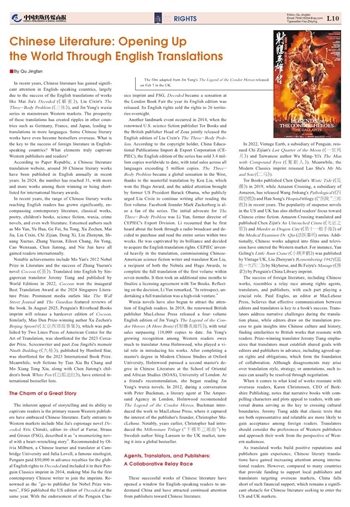
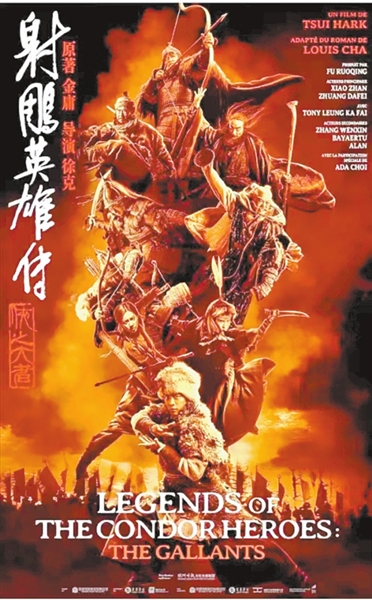
Wuxia novels have also begun to attract the attention of English readers. In 2018, the renowned British publisher MacLehose Press released a four-volume English edition of Jin Yong's The Legend of the Condor Heroes (A Hero Born) (《射雕英雄传》), with total sales surpassing 110,000 copies to date. Jin Yong's growing recognition among Western readers owes much to translator Anna Holmwood, who played a vital role in introducing his works. After completing a master's degree in Modern Chinese Studies at Oxford University, Holmwood pursued a second master's degree in Chinese Literature at the School of Oriental and African Studies (SOAS), University of London. At a friend's recommendation, she began reading Jin Yong's wuxia novels. In 2012, during a conversation with Peter Buckman, a literary agent at The Ampersand Agency in London, Holmwood recommended The Legend of the Condor Heroes. Buckman introduced the work to MacLehose Press, where it captured the interest of the publisher's founder, Christopher MacLehose. Notably, years earlier, Christopher had introduced the Millennium Trilogy (“千禧年三部曲”) by Swedish author Stieg Larsson to the UK market, turning it into a global bestseller.
Agents, Translators, and Publishers:
A Collaborative Relay Race
These successful works of Chinese literature have opened a window for English-speaking readers to understand China and have attracted continued attention from publishers toward Chinese literature.
In 2022, Vintage Earth, a subsidiary of Penguin, reissued Chi Zijian's Last Quarter of the Moon (《一弦残月》) and Taiwanese author Wu Ming-Yi's The Man with Compound Eyes (《复眼人》). Meanwhile, the Modern Classics imprint reissued Lao She's Mr Ma and Son (《二马》).
Tor Books published Chen Qiufan's Waste Tide (《荒潮》) in 2019, while Amazon Crossing, a subsidiary of Amazon, has released Wang Jinkang's Pathological (《四级恐慌》) and Han Song's Hospital trilogy (《“医院 ”三部曲》) in recent years. The popularity of suspense novels in the US and UK has also shifted readers' focus toward Chinese crime fiction. Amazon Crossing translated and published Chen Zijin's An Untouched Crime (《无证之罪》) and Murder in Dragon City (《第十一根手指》) of the Medical Examiner Dr. Qin (法医秦明) series. Additionally, Chinese works adapted into films and television have entered the Western market. For instance, Yan Geling's Little Aunt Crane (《小姨多鹤》) was published by Vintage UK, Liu Zhenyun's Remembering 1942 (《温故一九四二》) by Skyhorse, and Bi Feiyu's Massage (《推拿》) by Penguin's China Library imprint.
The success of foreign literature, including Chinese works, resembles a relay race among rights agents, translators, and publishers, with each part playing a crucial role. Paul Engles, an editor at MacLehose Press, believes that effective communication between editors and translators is key to a book's success. Translators address narrative challenges during the translation phase, while editors draw on the translation process to gain insights into Chinese culture and history, finding similarities to British works that resonate with readers. Prize-winning translator Jeremy Tiang emphasizes that translators must establish shared goals with editors and publishers in advance, including agreed-upon rights and obligations, which form the foundation of collaboration. Although disagreements may arise over translation style, strategy, or annotations, such issues can usually be resolved through negotiation.
When it comes to what kind of works resonate with overseas readers, Karen Christensen, CEO of Berkshire Publishing, notes that narrative books with compelling characters and plots appeal to readers, with universal drama serving as the key to crossing cultural boundaries. Jeremy Tiang adds that classic texts that are both representative and relatable are more likely to gain acceptance among foreign readers. Translators should consider the preferences of Western publishers and approach their work from the perspective of Western audiences.
As translated works build positive reputations and publishers gain experience, Chinese literary translations have gained increasing attention among international readers. However, compared to many countries that provide funding to support local publishers and translators targeting overseas markets, China falls short of such financial support, which remains a significant obstacle for Chinese literature seeking to enter the US and UK markets.